Swedish Manufacturing Conference 2026
On 20–21 May, we co-hosted the annual Swedish Manufacturing Conference together with the Swedish Manufacturing R&D Cluster. Over two intensive days, representatives from industry, academia, and research gathered to discuss how to build a competitive and resilient manufacturing sector.
A central theme throughout the conference was how to future-proof our operations in an era marked by uncertainty and rapid change. Artificial intelligence was highlighted as a key enabler, with applications ranging from production and decision support to resource optimization and climate transition. At the same time, a recurring topic was the challenge of moving from testing and pilot projects to full-scale implementation that delivers real value.
Resilience was a highlighted theme – how do we prepare for the unknown and build systems that are both robust and adaptable. Sustainability clearly emerged as an integral part of this effort. The message was clear: sustainability is not only an environmental issue, but a core driver of both competitiveness and resilience.
The parallel sessions reinforced this perspective with topics such as resilient production systems, net-zero manufacturing, and mission-driven research in a rapidly changing. An important insight was that objectives often seen as conflicting – such as efficiency and flexibility, or reduced climate impact and increased competitiveness – are in fact closely interconnected and can reinforce one another.
Our recently launched report, Manufacturing Outlook, formed the basis for both a panel discussion and a workshop. The report shows that the manufacturing sector is reducing its emissions, but that the pace must accelerate to achieve net-zero by 2040. It also highlights that a significant share of emissions occurs outside companies’ own operations – within materials, energy use, transport, and supply chains.
The panel, featuring Björn Johansson, Chalmers University of Technology, Elin Haapaniemi, Siemens and Johan Svenningstorp, Volvo Group, emphasized that the transition is not slowing down. On the contrary, it is accelerating. Companies remain committed to their long-term goals and are stepping up their efforts. The momentum remains strong.
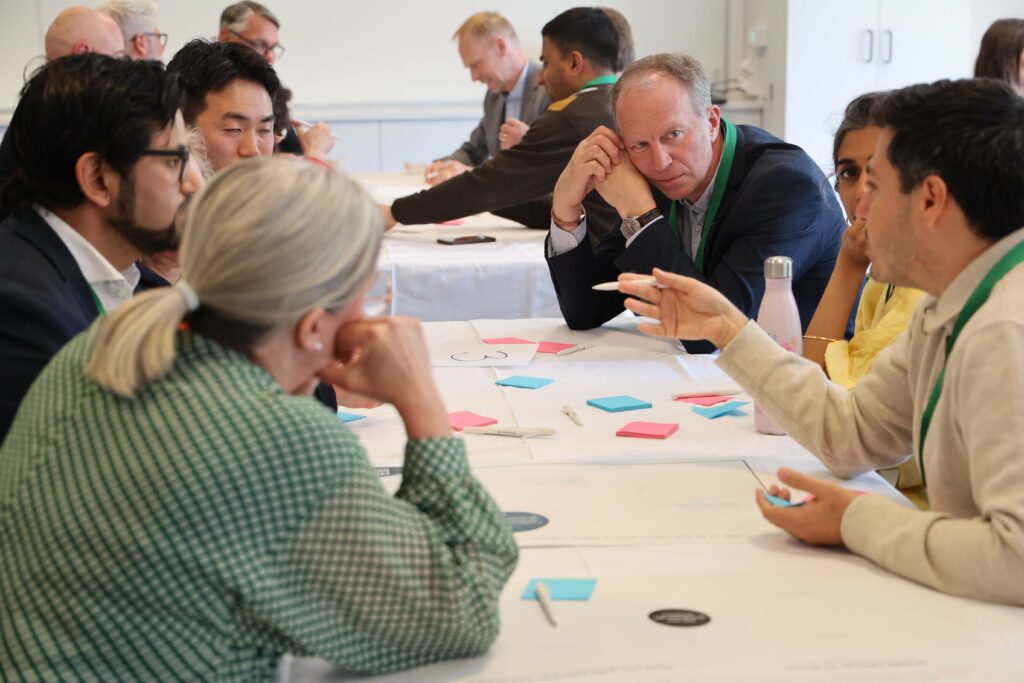
Our workshop brought together around 50 participants from across the ecosystem and focused on how to accelerate the transition to a manufacturing industry with net-zero greenhouse gas emissions. The discussions resulted in three clear and interconnected priority areas:
- Regulation, financing, and incentives need to support the transition and make sustainable choices economically attractive.
- Implementation and scaling are critical. Many solutions already exist – such as circular practices, reuse, improved data utilization, and smart design – but they need to be scaled up more rapidly, particularly among small and medium-sized enterprises.
- Collaboration is essential. No single actor can drive the transition alone. Partnerships between policymakers, industry, academia, and startups play a decisive role.
A recurring theme was the need to shift focus from individual initiatives to a systems-level perspective. Achieving real impact requires solutions that optimize entire value chains. In this context, the importance of scaling circular practices, especially reuse, was highlighted. As well as strengthening collaboration within supply chains, where larger companies have both a responsibility and an opportunity to drive change.
Many of the necessary solutions already exist. What is now required is an increased pace, improved coordination, and a shared commitment to implementation. Three key factors were identified as critical to accelerating progress:
- Stronger policy instruments and financial enablers
- A focus on scaling what already works
- Broader engagement across the entire ecosystem
Swedish Manufacturing Conference 2026 demonstrates that the transition to a sustainable and resilient industry is not only necessary – it is already well underway. The focus now is on increasing the pace and advancing together.
Thank you to everyone who participated and contributed to interesting discussions and conversations. Many thanks as well to our projects that were present and presented their results and future plans.